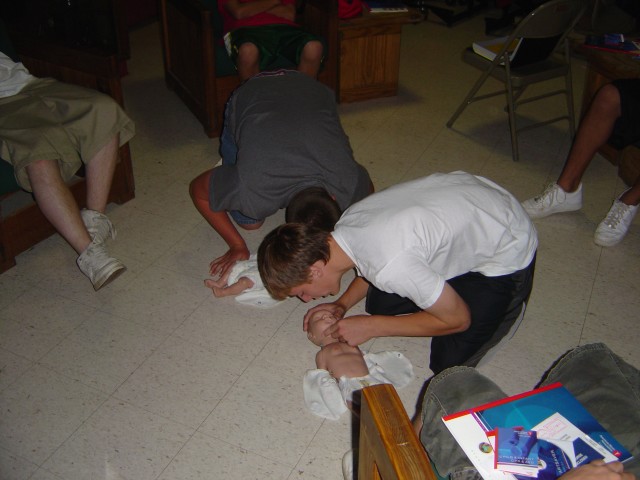
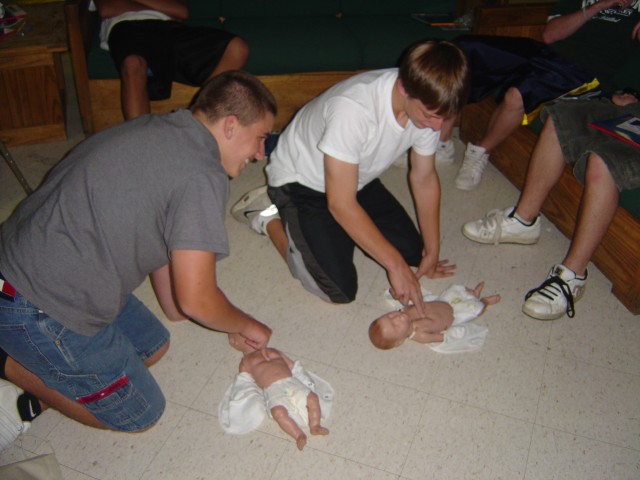
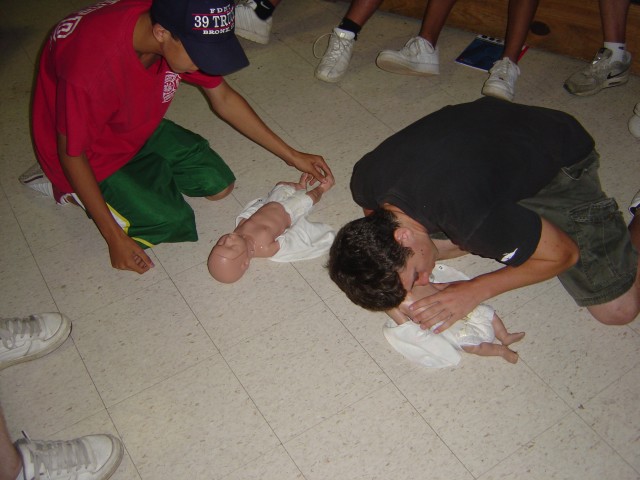
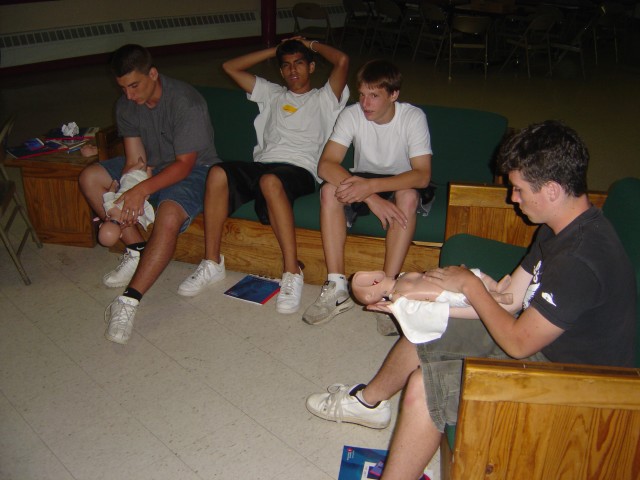
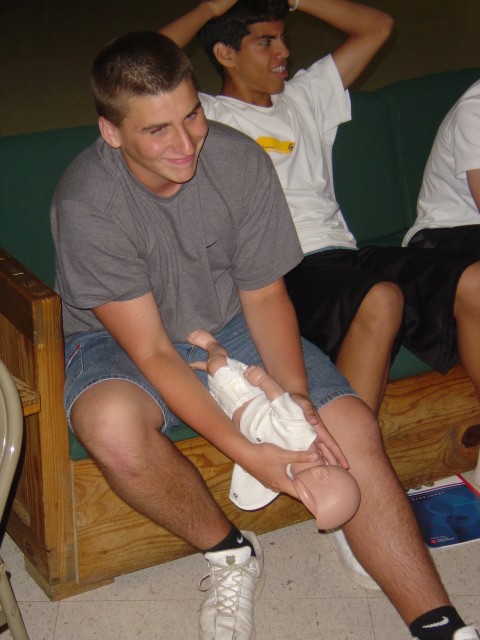
Wednesday night members of the Junior Corp took part in there yearly CPR-D training. CPR Instructor Jeff Wilson had his hands filled teaching CPR to newer members of the corp. It seams that the newer members wanted to do there training on one of the older members. I guess they needed to keep him awake. Realizing the importance of the class they got down to business. With all the new changes in the protocols the group knew they had to get this class completed. Many of the members also are lifeguards and need for there jobs.
Every one should know how and when to administer CPR. When performed correctly, CPR can save a child's life by restoring breathing and circulation until advanced life support can be given by health care providers.
What Is CPR?
The letters in CPR stand for cardiopulmonary resuscitation, a combination of rescue breathing (mouth-to-mouth resuscitation) and chest compressions. If a child isn't breathing or circulating blood adequately, CPR can restore circulation of oxygen-rich blood to the brain. Without oxygen, permanent brain damage or death can occur in less than 8 minutes.
CPR may be necessary for children during many different emergencies, including accidents, near-drowning, suffocation, poisoning, smoke inhalation, electrocution injuries, and suspected sudden infant death syndrome (SIDS).
Reading about CPR and learning when it's needed will give you a basic understanding of the concept and procedure, but it's strongly recommended that you learn the details of how to perform CPR by taking a course. If CPR is needed, using the correct technique will give your child the best chance of recovery.
When Is CPR Needed?
CPR is most successful when administered as quickly as possible, but you must first determine if it's necessary. It should only be performed when a person isn't breathing or circulating blood adequately.
First, determine that it's safe to approach the person in trouble. For instance, if someone was injured in an accident on a busy highway, you'd have to be extremely careful about ongoing traffic as you try to help. Or if someone touched an exposed wire and was electrocuted, you'd have to avoid contact with the wire to prevent becoming electrocuted yourself.
Once you know that you can safely approach someone who needs help, quickly evaluate whether the person is responsive. Look for things like eye opening, sounds from the mouth, or other signs of life like movement of the arms and legs. In infants and younger children, rubbing the chest (over the breastbone) can help determine if there is any level of responsiveness. In older children and adults, this can also be done by gently shaking the shoulders and asking if they're all right.
The next step is to check if the victim is breathing. You can determine this by watching the person's chest for the rise and fall of breaths and listening for the sound of air going in and out of the lungs. In a CPR or basic life support (BLS) course, participants practice techniques for determining if breathing or circulation is adequate. If you can't determine whether someone is breathing, you should begin CPR and continue until help arrives.
Whenever CPR is needed, remember to call for emergency medical assistance. Current CPR courses teach you that if you are alone with an unresponsive infant or child, give chest compressions for 5 cycles (about 2 minutes) before calling for help.
Three Parts of CPR
The three basic parts of CPR are easily remembered as "ABC": A for airway, B for breathing, and C for circulation.
" A is for airway. The victim's airway must be open for breathing to be restored. The airway may be blocked when a child loses consciousness or may be obstructed by food or some other foreign object. In a CPR course, participants learn how to open the airway and position the child so the airway is ready for rescue breathing. The course will include what to do to clear the airway if you believe an infant or child has choked and the airway is blocked.
" B is for breathing. Rescue breathing is begun when a child isn't breathing. Someone performing rescue breathing essentially breathes for the victim by forcing air into the lungs. This procedure includes breathing into the victim's mouth at correct intervals and checking for signs of life. A CPR course will review correct techniques and procedures for rescuers to position themselves to give mouth-to-mouth resuscitation to infants, children, and adults.
" C is for circulation. Chest compressions can sometimes restore circulation. Two rescue breaths should be provided and followed immediately by cycles of 30 chest compressions and 2 rescue breaths. It is not necessary to check for signs of circulation to perform this technique. This procedure involves pushing on the chest to help circulate blood and maintain blood flow to major organs. A CPR course will teach you how to perform chest compressions in infants, children, and adults and how to coordinate the compressions with rescue breathing.
(KIDSHEALTH/The Nemours Foundation) |


 Add a Comment
